Equipment for semi-finished food production: pancakes, dumplings, pasta
Pancake and dumpling machines and pasta equipment for producers of frozen and chilled semi-finished foods. AR-TECH selects machines for your product and volume and prepares a commercial proposal.

Equipment types
Applications and products
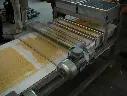
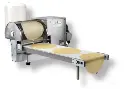
This range covers three groups of dough-based products: pancakes (including filled ones), dumplings and other filled products, and pasta. It is aimed at small and mid-sized workshops, food-service kitchens, producers of frozen semi-finished foods and businesses that want to move from manual work to steady output with consistent weight and shape.
The catalog has three subcategories: pancake machines, dumpling machines and pasta equipment. The machines come from ITALGI, La-Monferrina and under the HARVER brand.
For any of these products the key criteria are the same: stable product weight, repeatable dough thickness, quick changeover between recipes and the ability to wash the equipment between shifts. These are what machines should be compared on, not only the stated capacity.
The process, stage by stage
Pancakes
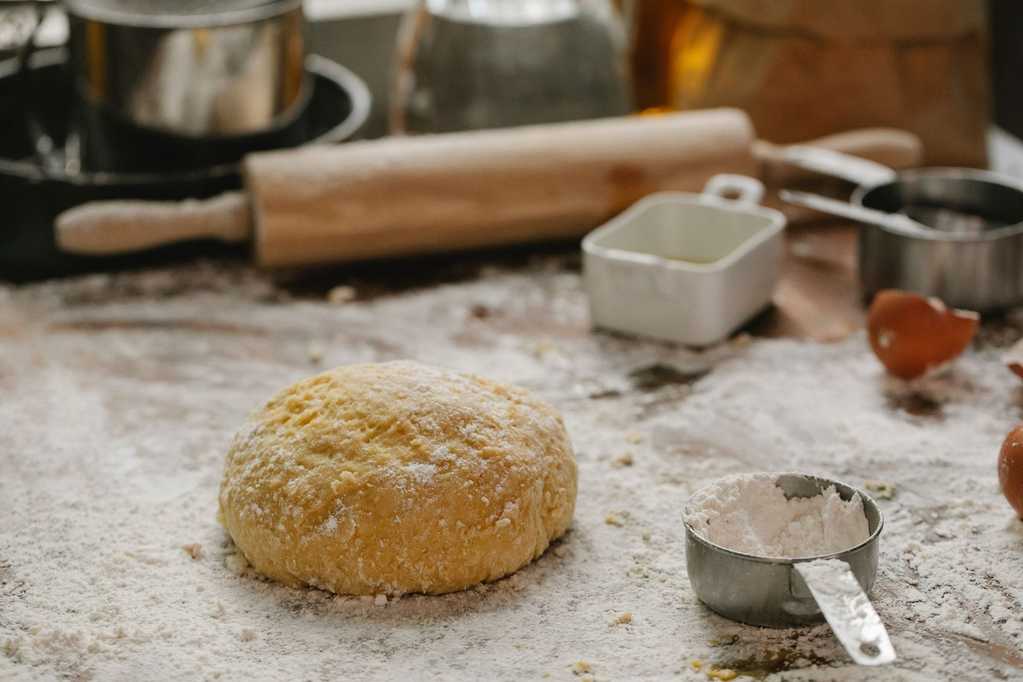
- Batter preparation. Flour, eggs, and milk or water are mixed into a smooth liquid without lumps.
- Baking. The batter is applied in a thin layer to a heated surface where the pancake bakes. The evenness of the layer sets the uniform thickness and weight of the product.
- Cooling. Finished pancakes are cooled so they do not stick together when stacked.
- Filling and folding. If required, filling is added and the pancake is folded or rolled, then passed on to freezing or packing.
Dumplings and filled products
- Dough mixing. Flour, water and other ingredients are mixed into a uniform mass, which then rests so the gluten can develop.
- Dough sheeting. The dough is rolled out to the required thickness.
- Filling and forming. The filling is dosed into the product, the edges are sealed and the shape is formed. A constant filling mass is important for uniform portion weight.
- Chilling or freezing and packing. For frozen semi-finished foods the product is frozen quickly so that it keeps its shape.
Pasta
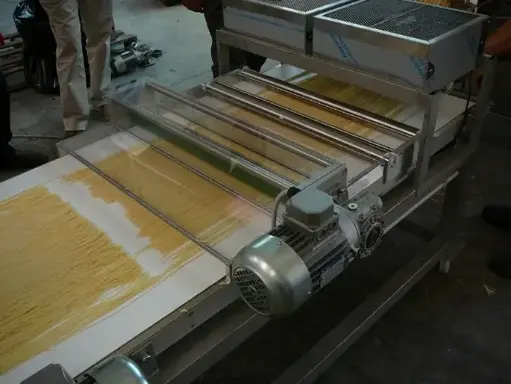
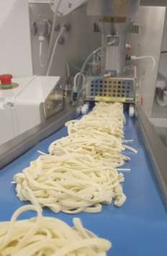
- Mixing. Flour and water (and eggs, according to the recipe) are mixed to the required dough moisture.
- Forming. The dough is formed by extrusion through a die, or rolled into a sheet and cut, depending on the product type.
- Drying or freezing. Dry pasta is dried, while fresh pasta is chilled or frozen for storage.
- Packing.
How to choose equipment
- Product range. One product or several: this decides whether you need interchangeable forms, dies and quick changeover.
- Throughput. Base it on real output per shift and on the capacity of the following stages, freezing and packing, so that the line is balanced.
- Dough and filling type. Dough density and stickiness, and filling moisture and particle size, affect the type of dosing and forming.
- Automation. Stand-alone machines or a linked line with minimal manual work.
- Sanitation. Food production needs surfaces that are easy to wash and access to the parts that contact the dough.
- Raw materials and storage. Flour quality affects the dough, and cold and freezer capacity shapes the whole plant layout.
Why AR-TECH
- We manufacture machines under the HARVER brand and supply industrial equipment from the EU for processing agricultural produce.
- This range features ITALGI, La-Monferrina and HARVER.
- We select machines for your product and volume and prepare a commercial proposal.
- You can start with one machine and expand production with new ones.
To request a selection, use the contact form. Other ranges are in Solutions, and manufacturers on the Brands page.
Equipment in action


Popular equipment in this direction
All products →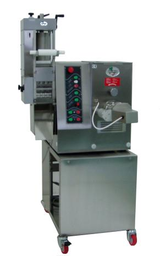
Manufacturers in this direction


Frequently asked questions
We will select equipment for your product and volume
Describe your task and we will prepare a solution and a quotation.
Send a requestФото: Klaus Nielsen (Pexels), Ray Suarez (Pexels), Xavier Messina (Pexels)